Showing posts with label Campus Visits. Show all posts

Tuesday, August 18, 2015

Roanoke College and U Richmond will be visiting soon!


Roanoke College's Office of Admissions warmly welcomes prospective students with individualized tours that exemplify the small, close-knit community of this liberal arts college in Salem, VA.  The college is reading and writing intensive - across the curriculum - and in the spirit of its Lutheran tradition, encourages students to expand their intellect by questioning everything.  It's a bit unusual for a liberal arts college to boast such a notable business program but Roanoke's is top notch, as are education (with an emphasis on teaching in a diverse classroom), sociology, history and biology and biochemistry.  This diverse family of 2,000 undergraduates have been likened to "explorers" rather than "tourists" who want to roll up their sleeves - either in the cadaver lab or the on-campus organic garden - and really experience and take advantage of the rich opportunities available.  Another unique offering is the undergraduate research assistantship program with provides a multi-year track beginning in freshman year.  Finally, Roanoke is in an elite group of less than 300 colleges nationwide with a Phi Beta Kappa honor society chapter.  To learn more, talk with Courtney Penn, TN recruiter for Roanoke, at GPS' first college night on August 31.  


The University of Richmond is often overlooked by high-achieving GPS students: a fact that needs to change! With a more palatable acceptance rate than other selective schools of 30%, Richmond's 3,000 undergrads are intellectually curious and capable, embracing collaborative learning and encouraging positive group dynamics.  Think: deep conversations which continue from the classroom
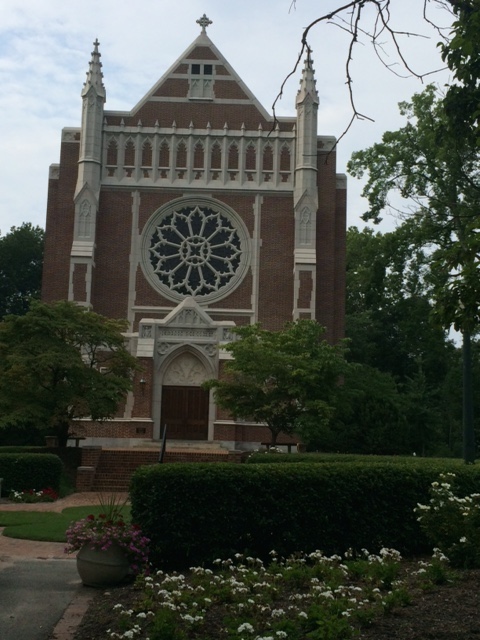
to the quad, onto the dining hall and dorms.  Only 18% of students hail from Virginia with large concentrations coming from both coasts.  The school values diversity: 25% minority, 14% first generation and 10% international students and it also values accessibility: operating on a need-blind admission basis, meeting 100% of students' demonstrated need.  "The Richmond Guarantee" ensures every single undergraduate a paid (up to $4,000) summer internship or research experience and the Jepson School of Leadership Studies trains developing leaders to look at leadership through a variety of lenses including critical thinking, public speaking and group dynamics. All students apply to Richmond as "undeclared" but designate an area of interest.  I loved everything about UR and downtown Richmond reminded me of a larger, more grown-up Chattanooga.  Michael Richardson will be at the August 31 college night to share more insights about this gem of a school.  

Monday, May 4, 2015

From San Francisco to South Carolina

During the month of April I had the good fortune to visit several college campuses, and I want to offer a quick snapshot of a few of them.

1.  For girls who are considering a big city, you really should take a look at the University of San Francisco.  Home to around 6,000 undergraduates (that hard to find medium size school), USF is a wonderfully diverse campus that is always on the lookout for students who are engaged in their school and community.  A Jesuit university, it is only about 30% Catholic, and all faiths are more than welcome.  Signature programs include nursing, communications, international studies, architecture and urban planning, data science, entrepreneurship, hospitality management, and performing arts (a major you can combine with social justice).  They should also be opening an engineering program in 2017.

I found the University to be open, inclusive, and very
University of San Francisco
comfortable. They have created a learning environment that integrates every student into the community, and students inevitably leave asking "How can I use my gifts to make the world a better place?"  Like all Jesuit schools, they emphasize justice, compassion, grace, integrity, and humanity.

Because of their location (and an excellent career services office), finding internships is not hard to do.  After all, San Francisco is home to Twitter, Google, LinkedIn, Apple, Sales Force, Pandora, and Yelp, just to name a few.  Not as competitive as some schools in big cities (NYU, Georgetown, GW, or BU), it is a fantastic option that you should investigate.

2.  It's been a while since I visited Clemson University, so it was fun to go back and see what's new. They have an undergraduate research program called "creative inquiry," where students can research things like "Are double stuff oreos really double-stuffed?" or "can you really pick up dropped food and eat it if it's only been there for five seconds?"  So not only can you get real research practice, but you can do it while investigating a less serious topic.

Another interesting major at Clemson is packaging design (one of only four or five schools in the country that have it).  From start to finish, a PD major focuses on packaging construction and marketing (consumer interaction) and packaging design and management.  Clemson has also opened a beautiful architecture building, complete with open air studio and nooks for presentations.  No portfolio is required, but the major is pretty intense. Nursing, agriculture, business (marketing), and education are strong majors, as is, of course, engineering.

Finally you should check out the Calhoun Honors College.  The SAT/ACT minimum is around 1320/30, and demonstration of intellectual engagement and involvement in activities is important for admission.

If you want to know more about these schools, or my stops at Wofford, Furman, the University of South Carolina, and the College of Charleston, stop by my office and let's talk.


Wednesday, March 19, 2014

Before hitting the road...

Because many of you are going to visit colleges over spring break, I wanted to offer a few last minute reminders/suggestions.
  • First, please sign in at the admissions office.  You want them to know you were present for the information session and tour. If there's something specific you want to see - like residence halls, art studios, or science labs - ask if you can see them.  If they're not on the tour, at least find the buildings and perhaps you can see them on your own time.
  • Take the time to peruse the school's website before you go. Many of the answers to your questions are easily accessible there.  Instead of asking "What's the average class size?" ask "What are the largest classes on campus, and where are they held?" Rather than ask if they have study abroad programs, ask how many students actually study abroad and what countries they typically visit.  You can easily find out whether they have a Greek system, so ask how many students are involved, are their events open to "outsiders," and if you are not interested in Greek life, what does the school do to promote other social activities?  Find out where the central gathering place for students is; that is, if there is one.
  • Please, please don't walk at the back of the tour. Walk up front with the tour guide.  She or he is an actual live college student and can provide you with lots of inside information if you'll just ask.
  • I highly recommend spending at least a few minutes without your parents.  Go off on your own and see how you feel..
  • Take the time to walk or drive around the surrounding community. This might be harder to do if you're visiting, say, Boston University, but get a feel for the place you might call home for four years.
And last but not least, based on both the information you have received and your own gut feeling, keep asking yourself if this is a good fit for you.  Consider these six things: campus culture, academic programs, student life activities, the off-campus environment, the climate for (take your pick): women, students of color, religious beliefs, or cultural background, and your academic profile. In other words, what are the chances you will be admitted.

Remember that your college counselor wants to hear from you when you return to school.  Let us know what you liked and didn't like...that will help us help you better.

Have a great trip, be safe, and enjoy your spring break.

Wednesday, March 12, 2014

College Road Trips

Spring break is just around the corner, and many juniors are getting ready to visit potential colleges.  Most have signed up for the campus tour and information session, but how can they make the most of the opportunity?

When you sit in as many information sessions as we have, you hear the same questions being asked over and over again: "Do you have study abroad?" "Can I study German and philosophy?" You can answer those questions just be checking the websites, so consider other questions you might ask that will give you a better understanding of the campus culture, the type of students who thrive on campus, the opportunities for women.  For example, I always like to ask an admissions rep what type of student feels the most at home on their campus.  Are there certain types of students who will "fit" the culture better than others?  You already know to ask if the college will recalculate your GPA, but also ask if "demonstrated interest" plays any part in the admissions decision.  Some schools do consider if you have visited campus or made other contact with the admissions office when considering your application.  They want to know if you are a serious candidate or not.  Academically speaking, you also need to know what is required of you and what they're looking for in an applicant. Special note for parents here:  let your daughter ask most of the questions.  College admissions reps want to hear from students more than parents.  Your daughter is the one who is trying to forge a relationship with the school, and she is the one who will be applying to college, so encourage her to speak up and save your questions, if you must ask them, until the end.

When you start your campus tour, don't hang around in the back.  Walk up front with the tour guide, so you can strike up a conversation.  Ask your tour guide why he or she chose that school? What was it about the college that connected with him/her? Don't worry about sounding like a high school student...YOU ARE! So if you want to know if the campus is friendly or involved, ask.  If it is important to you that students support the fine arts or athletics or service, ask.  If you want to know how accessible professors are, or if you ever see professors outside of class (like at sporting events, at the dining hall, or at performances), ask. Don't be afraid to ask a student how much time he or she spends studying. Don't hesitate to ask if there are things your guide would want to change about the university.  Ask about her favorite classes and her least favorite ones. Ask what campus activities draw the most interest and whether or not the Greek culture rules the social scene.  If you're worried about a party culture, ask about that too.  Mrs. Goldbach always notices how many students are wearing school sweatshirts or school colors.  However, remember that your tour guide is human, and some of them are better than others. If you like a school, don't let one person keep you from finding out more.

After the tour, don't just jump in the car and leave.  Hang out in the student center for a few minutes. Inquire about eating in the dining hall (they may give you a guess pass).  Read the student newspaper; check out bulletin boards.  And when you do leave, drive around the surrounding area.  Rather than eat in the cafeteria, you might prefer to eat at a local hang-out (ask the admissions office or a student for recommendations).  All of those things will help you understand the college or university a little better.

Take the time to write down your impressions.  Take some pictures so you don't get one school confused with another.  Then talk the experience through with your parents and/or your counselor. That's what makes a thorough campus visit.

Safe travels!

Wednesday, September 11, 2013

Narrowing Down the College List

Megan recently wrote about the process she's going through as she whittles down her college list. You can, as she did, go through all the mail and sort into three categories - yes, maybe, and no.  But looking at brochures will only get you so far.  What other questions should you be asking yourself?
Zinch, a college/scholarship search web site, recently offered five good questions you should think about as you create your own college list. 

Any time you visit a college campus, talk to a representative or even read The Fiske Guide, you should ask seriously ask yourself: "Can I see myself at this school? What academic and extracurricular opportunities would I take advantage of?" 

Many times when Mrs. Goldbach and I visit colleges, we can almost immediately think of a student who would not only benefit from the college community, but would also add something to it.  Now, not everyone is hit by a thunderbolt, but you should spend some time thinking about how you would fit into the college community. And of course, if you want some suggestions, your college counselor is always willing to assist you.

And just as an aside, I like Zinch's motto "I am more than a test score." That is absolutely true. You are.

Tuesday, September 10, 2013

29 Colleges...Where do I begin?

If you're coming to tonight's GPS/McCallie college program, you will have the opportunity to visit with twenty-nine different colleges and universities from all over the US.  There will be large, state schools, along side smaller liberal arts colleges, each one with something to offer you.

So where do you begin?  If you're a junior and just beginning this process, make sure to talk to a few schools that you know nothing about.  Sometimes those are the ones that end up being most appealing.  If time is limited, maybe you skip the college that is close by and you can visit easily.  Concentrate on the ones that are a bit further away.

Always introduce yourself.  And try not to just say "tell me about your college."  Instead, tell the rep something about yourself, what you're interested in, what your strengths are, and then he or she will take it from there.  Find out what their basic requirements are.  Ask about what a typical freshman year might look like?  If the rep also went to school there, find out why she chose the college?  More than likely you can get a list of majors and things to look over later, so spend your time trying to figure out what kind of campus culture there is.

And have fun.  Right now, you're just exploring.  You don't have to make a decision yet.

Oh, and make plans to attend next week's fair on Sept. 17 at McCallie.

Tuesday, August 27, 2013

The College Visit

I can't imagine deciding to attend a college without having visited it first.  I've only known two of my students who did that, and one was my own daughter!  To be fair, the school under consideration was in Europe, so we couldn't exactly stop by for a quick visit.  Fortunately for Jordan, it worked out, but the other student only lasted a semester.

When you visit colleges, what are the things you should do? Well, of course you should attend the information session and take the formal tour, but that's not all.  Yes, you should check out bulletin boards and pick up the school newspaper to see what's happening on campus, and you should talk to students besides the tour guide (although you should be at the front of the tour, so you can ask lots of questions of your guide).  And if possible you should attend a class or better yet, two very different classes.  But you should also spend some unstructured time on campus.  Ditch your parents for a while and walk around by yourself. I have a friend who used to say he'd love to make videos of all the parts of campus the school didn't take you to see! Sit in the student center and just people watch. Have lunch or dinner at a local diner or pub (bring your parents for this part, so they can pay).

In addition to the misconceptions about campus visits in this piece, don't rely on the "big game" weekends to tell you what you need to know. Remember, there are only about five or six home football games at any school, so you'll have the rest of the school year to figure out what to do on weekends.

Visiting campus is a little like trying on jeans.  More often than not, you have to try on a lot of them before you find the one that fits just right.  The more campus visits you make, the more you will discover what fits your needs, and the easier your final decision will become.

Friday, June 7, 2013

Visiting colleges this summer?

If you're headed out on a college tour this summer - and we hope you are - this mother's perspective might give you a few ideas.  While I'm not sure a student tour guide can really tell you if the professors are happy or not, most of her suggestions are good ones.

I would add that it is always a good idea to spend some time walking around campus on your own. An even better idea is for you to go in one direction and your parents can go in the other.  Maybe you can just sit in the student center and just watch and listen. See if you can find the building or rooms you're interested in, like the theater or science labs. Then you can come back and compare notes with the folks.  Also, see if you can find an off-campus hangout for lunch.  Put it all together, and you'll start to figure out if it "fits" or not!

Monday, February 11, 2013

Florida Southern College


View of Lake Hollingsworth
from a freshmen dorm

Warm weather? Check. Beautiful campus? Check. Strong majors in nursing, education, the sciences? Check, check, check.  Florida Southern College, located in Lakeland, Florida, a city of 98,000 and 38 lakes, might be an excellent option for you if you're looking for all those things are more.  Designed by the famed architect Frank Lloyd Wright, the campus sits on Lake Hollingsworth and offers spectacular views from some of the freshmen dorms and the fitness center.

Academically you will find plenty of hands-on, experiential learning opportunities, and they're looking for students who want to be active participants both in and out of the classroom. 

The low esplanades keep out the
rain and the hot Florida sun.

Last year's average GPA for accepted students was a 3.4 and test scores ranged from 1010-1160 or 21-26 (middle 50%).  In addition to the majors mentioned above, new majors include marine science and musical theater.  Interested students are guaranteed a travel study experience (at home or abroad) at no aditional cost, an internship at some point during their college career, and an on-time graduation in four years.

Florida Southern College is an impressive place and worth a second look!

Thursday, January 31, 2013

My College Visits


Wellesley College

Like you, we're often on the road visiting colleges and universities across the United States. I've recently returned from visiting Babson College, Olin College of Engineering, and Wellesley College.  Although each school is unique, perhaps what is most interesting about them is the collaborative program that they have with each other.  For example, you may be interested in pursuing chemical engineering at Olin, but you can combine that with entrepreneurship at Babson.  Or you may study business at Babson, but want to combine that with a language study from Wellesley.  There are all sorts of combinations.

Babson College specializes in business and entrepreneurship, in fact it's entirely devoted to it; Olin College is devoted to engineering and specializes in its project based approach to the subject.  Both schools emphasize collaborative learning, and the networking and internship possibilities are   excellent!  Wellesley College, of course, is an all-women's college, but rather than turn up your nose at the thought of it, you should at least take a look.  Just walking the halls with all the pictures of their famous alumni - Madeleine Albright, Hillary Clinton, Nora Ephron, Diane Sawyer - just to name a few. It's an outstanding school for the natural sciences, political science, international relations...just about everything!  Each school is different, but individually and together, they're worth considering.

Friday, October 19, 2012

It is the Third Week of Block Two at Colorado College!


Bernis Hall
What is the world does "Third Week of Block Two" mean?  It means Colorado College (CC for short) students are currently engaged in focused classes including: "Women and Madness" which examines the historical concept of madness as a psychological illness from the feminist perspective.  Or, freshmen are in a first year experience course exploring the peoples, cultures, histories and physical settings that have come to define the Southwest region.  The History of Performance class introduces periods of historical significance through the artistic lens of theatre and dance in Western culture.  These classes characterize CC's unique single-class block schedule in which students immerse themselves in the study of one class for 3 1/2 weeks, typically 3 hours per day.  The style isn't for everyone, but the 2,000 undergrads that call CC home can't imagine learning and engaging any other way.

Washburn Field
 CC's unique intellectual adventure is located on a equally unique and awe-inspiring campus in the town of Colorado Springs.  One has to possess an explorer's heart to attend CC and take advantage of the residential environment that draws students from across the country.  DIII athletes (excluding men's hockey and women's soccer which are DI), practice on Washburn Field in the shadow of the Rocky Mountains. 


Shove Chapel is located in the center of campus, adjacent to the school's Labyrinth, and was donated to the college with the understanding that it would always serve as a house of spirituality for people of all religions, faiths and beliefs.  The current schedule of varied services certainly confirms its use.

So, if the idea of never cramming for 4 or 5 midterms or finals at one time appeals to you, consider CC.  Also, I can't imagine any student who wouldn't enjoy 4 days of vacation between each block!


Tuesday, October 16, 2012

CU Boulder is arguably one of the "Most Beautiful Campuses" Anywhere

The majestic Flatirons of Boulder provide an impressive backdrop to the Univeristy of Colorado, Boulder's Farrand Field and Stadium Building.  Denver, just 30 miles east, offers students all the opportunties of a major city while the serenity and isolation of the Continental Divide is located just 30 miles north.  Exceptional programs include Journalism/Mass Communication, Engineering, Music and the Leeds School of Business. CU Boulder encourages significant study abroad travel and is considering making a global experience a graduation requirement. 

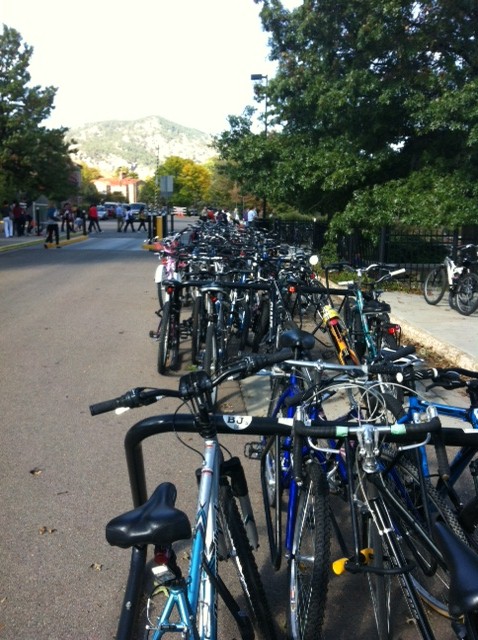
I know I've never seen as many bikes on a college campus before and skate and long boards are also very popular.  Students take advantage of their gorgeous environment, hiking and rock climbing in their backyard or road tripping to the 11 ski resorts within an easy 3 hour drive.   If food is important to you, you'd be hard pressed to find more extensive (and delicious!) dining hall options.  During lunch I sampled fresh rolled sushi, Persian food with incredible Nan, spring rolls and stir fry and Kosher Matzo Ball Soup.

Many of the residence halls feature an academic component which means that required courses are taught by full time faculty in a small classroom within your housing complex, typically capping at 25 students.  Cheyenne Arapaho is home to the new Health Professionals Residential Academic Building which just opened in fall, 2012. 

CU Boulder is known as a "Best Value" college claiming the second highest starting salary potential for undergrads, averaging $48,000.  There are clearly many reasons to take a second look at Boulder and consider becoming a "Buff"!


Tuesday, July 17, 2012

My College Visits

While I hope my students have been visiting some colleges over the summer, I've also been on the road seeing a few schools AND staying in dorms.


Don't be fooled by the sparsely decorated
dorm room; I didn't have time to decorate.
What you can't see is the beautiful fireplace!
My first stop was Bryn Mawr, an all women's college located outside of Philadelphia. Now I know a women's college is a tough sell for GPS girls, but if you're willing to consider one, this is a good place to start.  Academic programs - both humanities and sciences - are very strong, and the fine arts (theater, dance) are also top notch. If you're feeling like you want a co-ed environment, you can take classes at nearby Haverford, Swarthmore, and the University of Pennsylvania.  It will be a challenging place, but small and stimulating classes will more than prepare you for the future.


While in Philly, I also visited Haverford and Villanova. Similar to Boston College in many ways, Villanova will offer you a more traditional college experience, complete with big-time athletics and Greek life. Home to around 7,000 students, popular majors include engineering, nursing, and business.
Haverford, on the other hand, is a small liberal arts college with around 1200 students. Perhaps because of its Quaker heritage, there is a very strong sense of community and has a very strong honor code. Consequently, students are able to schedule their exams at any time they want (including midnight if that's what you want to do) and take them without a proctor. In the Quaker tradition, the students meet each year to discuss and ratify (or re-ratify) the code. Academic programs are strong and admission is competitive. 

Finally, I spent several wonderful days living at Sarah Lawrence College in Bronxville, New York. Right off the bat I will tell you this school is not for everyone, but it is an outstanding opportunity for a girl who wants to be the architect of her own education.  First of all, there are no majors, rather students choose a concentration and that concentration may not be a discipline that's part of the  curriculum. For example, your concentration might be folklore, but it allows you to tie in literature, history, and anthropology. You will also work very closely with professors, meeting individually with each one on a bi-weekly basis. In addition to coursework, students also develop individual projects for each course like an academic research paper or field work or internships. Creative projects are also possible, and in fact, Sarah Lawrence has an outstanding fine arts program in both the visual and performing arts. Almost all classes are seminar style, although students are required to take a certain number of lecture based courses. Classes at SLC are also very writing intensive, but having sat through a writing class myself while I was there, it was not at all intimidating! There are many more unique things about Sarah Lawrence College, so come see me if you're interested.

Thursday, April 26, 2012

George Mason University

George Mason himself
I discovered another great university last week, and I highly recommend that some GPS students consider George Mason University in Fairfax, Virginia. 
Home to around 20,000 undergraduate students, GMU is a great place to go if you are interested in foreign policy, language, English, education, public policy, international affairs, or journalism.  They also have an excellent nursing program. And because it's so close to Washington D.C., there are plenty of internship possibilities. There's also a shuttle bus that runs in to D.C. on a regular basis.

George Mason is a public institution in Virginia, and although it is also a research institution, it is also a traditional liberal arts colleges.  Their current student profile is around a 3.3-3.6 with 1120-1250 or 23-28 test scores (this is the middle 50% score range).  It is also test optional, but you would need a 3.5 to be admitted without test scores.

Because George Mason University (they're the Patriots, of course!) is located in the suburbs, the campus is green, leafy, and wooded....very pretty!  What did I like most about George Mason  however? It is a very diverse campus, with friendly, motivated students from all over the world.  And it might be the perfect place for you!

Thursday, April 5, 2012

The College Adventures of Mrs. Goldbach and Ms. McCarter, Part II

The easiest way to best explain the feel of Hendrix College in Conway, Arkansas (30 miles from Little Rock), is to share a quote from a current freshman: "Hendrix has already made me a better person, period. I would have judged and written off a lot of people I now call my friend if I hadn't come here. After years of prep school elitism and homogeny, I am now appreciating the lack of stereotypes and the non-judgmental openness that characterizes the Hendrix community. In high school, I had a lot of restrictions that made me feel I had to act and look a certain way. Hendrix is allowing me to develop into my true self -- and I discover daily who that is!"

Hendrix prides itself on doing things a bit differently, left of center, and seeks students who want to be challenged, academicallly and socially. They accomplish this goal, in large part, through their unique Odyssey Program which distinguishes Hendrix from other selective liberal arts colleges. All 1500 undergrads must participate in this engaged learning program in at least three areas: Artistic Creativity, Global Awareness, Professional and Leadership Development, Service to the World, Undergraduate Research and Special Projects. Students gain disciplinary confidence and identifiable experiences by overseeing and owning their education.


Student organizations are extremely varied and often quirky, including clubs that support sword fighting, bee keeping, and skeptisim, as well as Heifer International, feminism and English tea. If you are looking for a place that is going to push you out of your comfort zone, in an idyllic campus setting, Hendrix is well worth researching. Don't be deterred by its location in Arkansas; the random group of students I talked with were from Denver, Philadelphia, Peachtree City, Ashville and Miami, and they chose Hendrix over Elon, UNC Chapel Hill, Bucknell, Pitzer and Davidson.

Friday, March 30, 2012

The College Adventures of Mrs. Goldbach and Ms. McCarter, Part I

While many juniors were visiting colleges over spring break, so were we! I started my journey at a large state university, the University of Georgia.  Most of you are familiar with UGA, but I have to admit that I have always thought of it as just “too big.”  But in reality, it’s not, and I understand why so many students are attracted to it.  Things I would recommend: the Honors program, the Terry School of Business, the freshman odyssey program (actually required for all freshmen), and the food, at least in the dining hall I visited. They’re also adding civil engineering this fall and mechanical/electrical engineering in the fall of 2012.  Slowly but surely the student body is becoming more diverse, but it’s also becoming more competitive, regardless of whether you’re in-state or out.

I moved on to Miami University of Ohio, a public university with around 14,000 undergraduate students. Miami’s focus is still on the liberal arts and undergraduate teaching, and their top five majors are psychology, zoology (for pre-med), political science, English (writing), and communications, which includes journalism.  However, I got a chance to spend some time in the Farmer School of Business, a beautiful, state-of-the-art building.  It’s a very hands on program and expect to spend part of your time with group projects. They have a ‘China Business Program’ and students are encouraged to study abroad while at Miami. The School of Engineering is also outstanding, with lots of opportunities for undergraduate research, internships, co-op opportunities, and service learning. Computer science/software engineering is a fast growing major within the school, and I like the fact that like the entire university, the School of Engineering is a combination of technical and liberal arts education. Not to be missed is the School of Education and the School of Fine Arts. If you want to know more about those programs, feel free to come see me. I left able to picture a lot of GPS girls being very happy on this campus, and if you like UVA, SMU, Vandy, or even UGA, you should check out Miami University as well.


Finally, I visited the University of Dayton.  As I expected, this Catholic school of around 7,000 students is extraordinarily friendly and community and service minded. Students at Dayton want to be part of a larger world and want to be involved in that world, and the school focuses on making connections between the curricular and co-curricular and on building community among diverse peoples.  International Studies includes a human rights major; students in the School of Engineering, an excellent  program, have the opportunity to work on projects for real clients; the School of Education includes the applied health sciences for students interested in becoming things like physical therapists or physician’s assistants. The sciences are also very strong at Dayton, and students will have lots of opportunities for research.  The campus is beautiful, so it’s no wonder that 95% of students live on campus all four years.  Juniors and seniors and the opportunity to live in the ‘student neighborhood,” a group of houses owned by the university.  You don’t have to be Catholic to attend, and at least to me, the school seemed more open or progressive than some other Catholic schools I have visited.  I highly recommend you consider UD!

Thursday, March 1, 2012

Quinnipiac University

Most of you may have never heard of Quinnipiac University in Hamden, Connecticut, but after my recent visit to the campus, I strongly encourage you to get to know this school.  Located only ten minues or so from New Haven (home of Yale University), this school of around 5,800 undergraduates is an outstanding place to go, especially if you are interested in health sciences (nursing, physical or occupational therapy,physician's assistant, sports medicine), business, or communications.  A medical school is set to open in the fall of 2013, and an engineering school is expected to open in the fall of 2014.  All in all, it's quite an impressive place!

Although the majority of their student body is from the northeast and mid-atlantic states, this is one campus where I think a GPS girl would be quite comfortable. In fact, I don't think it would be difficult to find your niche at Quinnipiac, whether you were interested in sports, religious organizations, Greek life, or anything else.

Quinnipiac is actually divided up into three campuses, but don't worry, it's not as bad as it might

Clark's Pond

The York Hill Student Center

sound.  The Mount Carmel campus houses all the academic buildings, a student center, and freshmen and sophomore dorms. There is quite an active social life on this campus, but remember, you're a short distance from New Haven as well, and there is a regular shuttle that will take you there. 

Juniors and seniors live on the York Hill campus, only a mile away.  In an effort to make it as convenient as possible, there is also a student center on this campus (it looks like a gorgeous ski lodge!), a cafeteria, and two gyms - one for basketball and one for ice hockey, a very popular sport on campus. Then there is the North Haven campus where all the medical facilities are located.  So, a senior might live on York Hill but will go to North Haven for her nursing clinicals, etc.  It is also where the new med school will be located.  I think it's time Quinnipiac University got some students from the southeast!!


Wesleyan University

If you're looking for a college that will challenge you academically and socially, you should consider Wesleyan University.  Located in Middletown, Connecticut, this college of around 2,800 students, is a strong liberal arts school and also has an excellent fine arts program (especially film studies). You might like that there is no core curriculum nor are there any distribution requirements, and it is possible to create your own major.  And as you can see from the pictures below, the architecture is as diverse as the student body!

   
The students at Wesleyan appreciate and embrace their diverse student body, tend to be social and political activitists, and tend to be on the liberal side.  All students live on campus, including seniors who lives in campus owned houses (so you'll have take your own trash out), and the food I tasted was really good! They also play Division III sports.
 
I think a good description of the typical Wesleyan student is that she (or he) is an individual, is curious and demonstrates a real love for learning, and wants to be part of a diverse student body.  Admission, however, is very competitive, so keep that in mind.

Tuesday, February 7, 2012

Tips for a Successful College Visit

Visiting Colleges Over Winter Break? Read on for helpful hints and smart suggestions…

Remember all the guidelines we’ve talked about regarding successful visits: ask for the business card of Admission Representatives you talk with; shake hands; introduce yourself, and then introduce your parent(s) rather than having Mom or Dad introduce themselves; and – most importantly – have a list of prepared questions ready. The following, compiled by the Colleges That Change Lives consortium, is yet another list of great questions to ask to find a good college fit:

ON THE ACADEMIC ENVIRONMENT
· Do faculty members hold students to high standards?
· How much time do students spend on work outside of class?
· What type of evaluations (exams, papers) do faculty members use most often?
· How do students receive feedback on academic work, and how often do they receive it?
· Do students work together on projects?
· How often are students required to do presentations in class?
· Are faculty members easily accessible?
· How often and how many students work on research projects with faculty?
· How often do students discuss ideas in class?
· Is there a required first-year program and a culminating senior year experience?
· Are students able to easily access courses outside their major?

ON THE CAMPUS ENVIRONMENT
· Do students and faculty serve together on campus committees?
· How many students participate in community-based service projects?
· How easily is it to be involved in student leadership activities?
· How many students study abroad?
· What do most students do for fun?
· Are there opportunities for spiritual activities?
· Are activities in fine arts, music and theatre limited to students majoring in these areas?
· What percentage of students are involved in athletics or intramural sports?

ON CAMPUS RESOURCES
· What types of financial aid and academic scholarships are available? Are they renewable each year?
· Who assists students with course selection and career advising? How often does this happen?
· How accessible are library and technological services?
· What safety/security services are available and how often do students use them?
· What health and personal counseling services are available?
· What career planning and job placement services and/or internship experiences are available? How early can these services be accessed? What data is available on graduate and professional school enrollment and job placement for students?

Thursday, October 20, 2011

Syracuse University - Finger Lakes #3

Syracuse University is home to some 13,000 students but if you apply to their College of Arts and Sciences, it's like attending a highly selective liberal arts college within the heart of a major research university. In other words, there is something for everyone at Syracuse. Strong programs abound including their renowed Newhouse School of Communication (Bob Costas and Steve Kroft are notable alums) and the School of Architecture. Downtown Syracuse is within walking distance of campus, offering an excellent art museum, an opera company, a symphony and plenty of local restaurants. Carousel Mall, a shopaholics dream with six levels of stores, is just 10 minutes away. Although it does get cold, football fans need not worry since games are played in the Carrier Dome, but basketball really rocks the house. There are plenty of study abroad opportunties since SU has nine fully staffed campuses around the world including Turkey, Chile and Hong Kong. Community spirit is evident from the minute you walk on campus and the students couldn't be friendlier.